
Open Today Sales: 9 AM-7 PMOpen Today Service: 7 AM-6 PMOpen Today Parts: 7 AM-6 PM
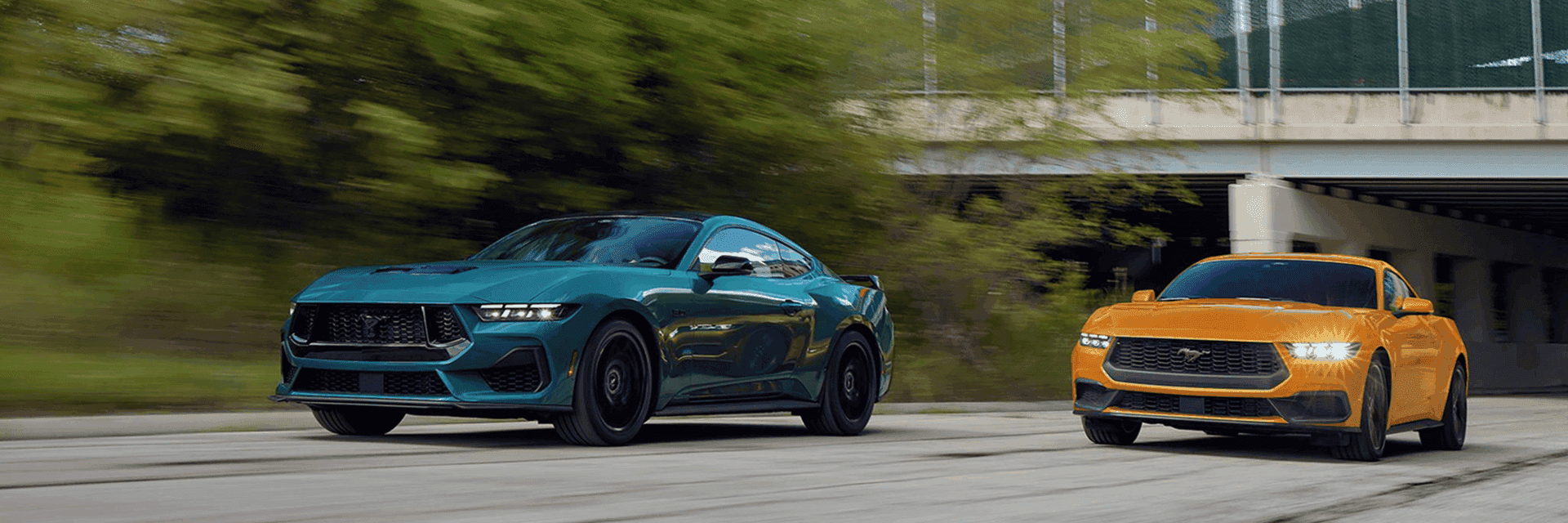
The Ford Mustang is recognizable among Birmingham drivers and drivers everywhere. For decades, this iconic vehicle has dazzled drivers with its one-of-a-kind design, high-speed capabilities, and fun maneuverability. But where did it all begin, and how did the Ford Mustang become the legend it is today? We go back in time to show you all about the unique Ford Mustang history, hopping from the first generation to the most recent version.
Explore the unique beginnings of the Ford Mustang with Tuscaloosa Ford!
The Ford Mustang premiered at Watkins Glen, New York, in 1962, first as a fiberglass show car and later as a fully functional vehicle. In 1963, the Ford Mustang came back to Watkins Glen, this time as a four-seater. With both years being a hit, the decision was made to debut the Mustang at the New York World’s Fair in 1964 to a much larger audience. The Mustang quickly gained popularity, and by 1966, one million Ford Mustang models had been assembled.
Over the decades, the Ford Mustang underwent several designs, upgrades, and other changes, which we cover in more detail below!
Many Bessemer drivers are familiar with the design of the current Ford Mustang, but they might not know that the Mustang looked a lot different when it was first built. We’ve put together a timeline of the Ford Mustang generations and the significant changes of the Ford Mustang over the years:
After its debut at the New York World’s Fair, the popularity of the Ford Mustang grew like wildfire. The success of the Mustang soon inspired competition, including the Chevy Camaro and the Dodge Challenger.
This generation gave rise to the Mustang II, which was slimmed down to be light, agile, and more fuel-efficient.
The Mustang was redesigned for 1979, and by 1987, the iconic look of the original Mustang had evolved into something more contemporary, eventually being dubbed the “Fox-Body.” By 1992, the Mustang was being offered in two-door notchback coupe, hatchback, and convertible styles.
The body of the Mustang started to take a smoother, more rounded shape, and base models were equipped with V6 engines that produced noticeably more power.
This generation of Mustang models started to blend its modern design with its original 60s look. Around this time, old rivals like the Dodge Challenger and the Chevy Camaro were reintroduced.
Boasting a similar design to the previous generation, this Ford Mustang was built with a whole new independent rear suspension system. Later models in this generation started to feature more powerful V8 engines and 10-speed transmissions.
The latest generation offers more advanced technology features and a slightly more angular design. It still maintains plenty of power, sporting improved turbo four-cylinder and V-8 powertrains.
The Ford Mustang almost had a completely different name! During its pre-launch period, it was nicknamed Cougar and was going to have an animal-themed logo from the start. After many redesigns, the horse-shaped logo was eventually chosen to represent this vehicle. Many interpret the horse logo as running in the opposite direction from the other horses in the pack, symbolizing independence. Many also interpret the logo as a symbol of freedom and the brand’s unique flair.
What does the Ford Mustang logo mean to you? Maybe it inspires you to drive around Centreville with confidence. Maybe it represents your own independence and willingness to go against the grain.
Whatever the logo means to you, you can experience the power of the Ford Mustang right here at Tuscaloosa Ford when you schedule a test drive!
Head on over to Tuscaloosa to feel the power of the Ford Mustang from behind the wheel. Choose from any model in our inventory, and see how much you can save with our new vehicle specials!
